Treasure NFT Details: Company, Website, Claims and Missing Evidence
Treasure NFT details: what can actually be established
| Field | Current evidence | Practical meaning |
|---|---|---|
| Name | Treasure NFT / TreasureNFT appears in regulator and industry records | The name is identifiable, but must not be confused with TreasureDAO. |
| Website | treasurenft.xyz is named by the Bank of Russia | A regulator record ties that domain to its warning entry. |
| India status | India’s 2026 parliamentary answer says crypto and NFTs are unregulated | This is not government approval of a platform. |
| Operator | No accountable operator is established in the cited primary records | Users should not infer ownership from unverified profiles. |
| NFT activity | No reproducible transaction set is provided in the official records | The trading claim requires contract and transaction-level proof. |
Why a registration number is not enough
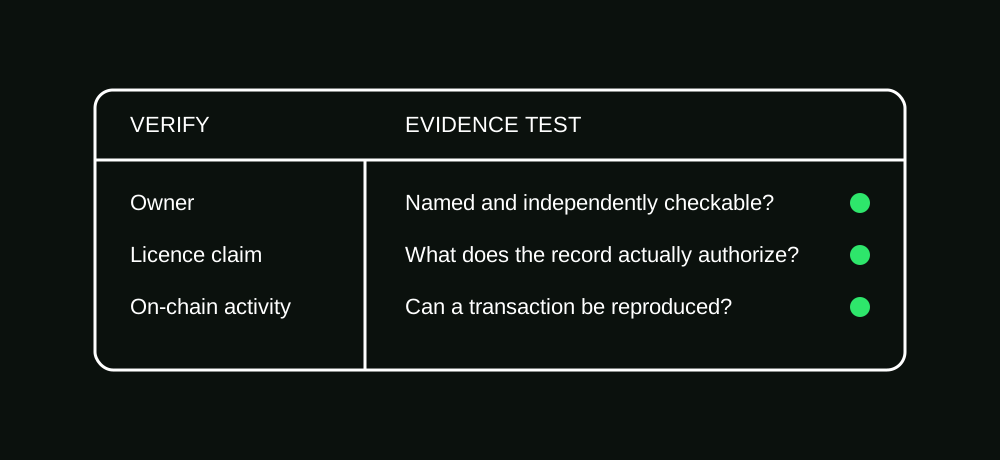
Financial platforms often display a company number, an overseas registration or a money-services entry. The correct question is what the record authorises. A corporate registration may show that an entity was formed. It does not establish that the entity may accept investments, promise returns, custody client assets or operate in India.
A credible review should link the original registry record, name the legal entity exactly and explain the scope of the registration. Screenshots without a registry URL are weak evidence because they can be edited or refer to a different company with a similar name.
The minimum on-chain proof for an NFT trading claim
To verify a claimed NFT trade, a reader should be able to identify the blockchain, collection contract, token ID, transaction hash, buyer address, seller address, sale currency and timestamp. Those fields should agree with each other on an independent explorer. An image of an NFT card, an internal order number or a profit figure is not a substitute.
Copy this due-diligence worksheet
- Record the exact domain and app-package name.
- Save the legal entity exactly as displayed, including jurisdiction.
- Open the original registry rather than a screenshot.
- Ask which licence covers custody or investment activity.
- Request three random NFT transaction hashes, not hand-picked screenshots.
- Check whether withdrawals require a fresh payment.
- Document who receives deposits and on which network.
Frequently asked questions
Who owns Treasure NFT?
The cited primary regulator records do not establish a verified accountable owner. Treat names appearing only in promotional profiles or copied articles as unverified until matched to reliable corporate and identity records.
Was Treasure NFT registered in India?
The available official Indian parliamentary answer does not describe Treasure NFT as an approved Indian investment platform. It says cryptocurrencies and NFTs are unregulated and directs scam reports to the cybercrime system.
Can a website trust score prove legitimacy?
No. Malware scans, SSL certificates and domain age measure technical properties, not whether an investment model is solvent, licensed or truthful.
What detail is most useful to verify first?
Start with the destination of user funds. A wallet address and transaction history provide more testable evidence than team biographies, certificates or marketing claims.