Is Treasure NFT Real or Fake? A Source-Based Risk Assessment
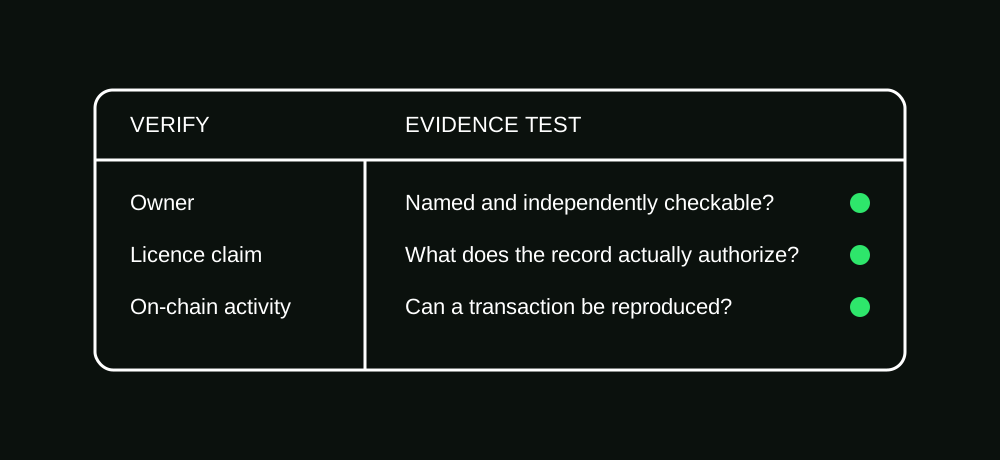
The correct verdict separates existence from legitimacy
A website, login page and user dashboard can all be real software. The financial question is whether the operator, assets, transactions and withdrawal obligations are independently verifiable. TreasureNFT fails important transparency tests in the public record reviewed here, while a regulator warning provides a direct risk signal.
Risk signals that deserve the most weight
- Regulator warning: the Bank of Russia lists signs of a financial pyramid.
- Unclear accountable operator: primary records do not establish an operator users can readily hold accountable.
- Weak external transaction proof: internal trades need public contract and transaction evidence.
- Withdrawal concerns: industry reports describe failed or frozen withdrawals and later successor claims.
- Name confusion: mixing TreasureNFT with TreasureDAO can import credibility from an unrelated project.
How this site grades evidence
| Grade | Example | Use |
|---|---|---|
| A | Government or regulator record | Supports a dated, attributable statement |
| B | Reproducible blockchain transaction or registry result | Supports a narrow technical fact |
| C | Named industry report with linked evidence | Useful with attribution |
| D | Anonymous post, screenshot or referral testimony | Lead only; not proof |
What an Indian reader should do now
Do not send a fresh payment to restore an account, migrate a balance or accelerate withdrawal. Preserve evidence and report suspected financial fraud quickly. If you are considering a different platform, verify its exact operator, India availability, fee terms and risk disclosures independently.
Frequently asked questions
Can a small successful withdrawal prove Treasure NFT was safe?
No. A small payout shows only that one transfer occurred. It does not prove the source of funds, solvency or the ability to honour larger future withdrawals.
Is a Telegram group with many members reliable evidence?
No. Membership, testimonials and screenshots can be coordinated or fabricated. Use primary records and transactions that can be independently reproduced.
Does a regulator warning automatically recover user funds?
No. A warning helps establish risk but does not itself create repayment. Victims still need to report promptly and preserve evidence.
Should users pay a recovery agent?
Be extremely cautious. Unsolicited recovery services often target people who already lost money. Do not share seed phrases, OTPs or remote device access.