Treasure NFT Transaction Hash: Verify a Deposit or Withdrawal
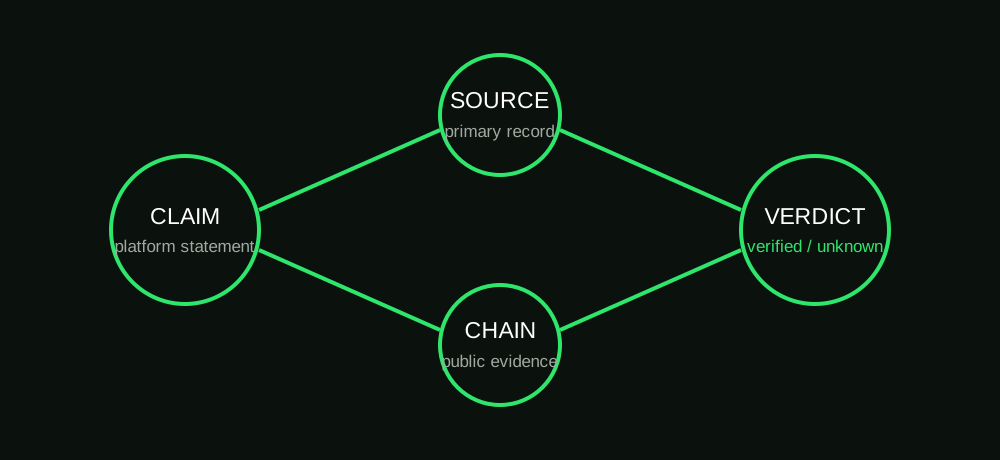
SERP research note: Search results for Treasure NFT Transaction Hash frequently repeat a conclusion without showing how to reproduce it. This guide makes the evidence fields and failure conditions explicit.
The practical answer for this search
Use the exact transaction hash on the correct block explorer to confirm status, amount, asset, network, sender, recipient and timestamp. The key is to preserve exact identifiers and test them outside the platform or message thread. Repetition across blogs, groups or screenshots does not turn a claim into independent evidence.
How to verify Treasure NFT Transaction Hash
Verify the network first, then contract address, token ID, wallet addresses and transaction hash. Open each identifier in an independent block explorer. A screenshot or internal order number cannot substitute for a reproducible public record.
| Step | Page-specific check | Evidence standard |
|---|---|---|
| 1 | Do not rely on a screenshot of a hash | Record the source, date and result. Mark unresolved facts instead of filling gaps. |
| 2 | Confirm token contract and decimals | Record the source, date and result. Mark unresolved facts instead of filling gaps. |
| 3 | Save an explorer link and timestamped copy | Record the source, date and result. Mark unresolved facts instead of filling gaps. |
How to interpret the result
Classify each result as verified, contradicted or unresolved. “Verified” requires a source that can be reopened by another reader; “contradicted” requires a record that directly conflicts with the claim; “unresolved” is the correct label when evidence is missing. Do not turn absence of evidence into a specific accusation.
A valid on-chain transfer proves that a transaction occurred. It does not by itself prove fair value, beneficial ownership, a legitimate counterparty or a promise of future returns.
What to do next in your jurisdiction
If the check reveals credential theft, an unexplained payment demand or suspected financial fraud, stop further payments and preserve the evidence. Contact the bank, wallet provider or exchange used for the transfer, then use the official cybercrime or financial-fraud channel in your jurisdiction. Do not publish seed phrases, OTPs or full identity documents.
Frequently asked questions
What is the first check for Treasure NFT Transaction Hash?
Start with whether a claimed transfer settled on-chain. Record the exact identifier and verify it through an independent source before acting.
What does a failed Treasure NFT Transaction Hash check prove?
It proves only that the specific claim was not verified or was contradicted. Preserve the result and avoid broader conclusions that the evidence does not support.
When should Treasure NFT Transaction Hash be reported?
Report promptly when the facts indicate suspected fraud, unauthorized access or a payment induced by deception. Use the official reporting channel for your jurisdiction and retain the case reference.
For Treasure NFT Transaction Hash, can a real NFT still be used in a misleading scheme?
For this Treasure NFT Transaction Hash check, yes. Token existence does not validate pricing, return claims, referrals or custody arrangements.